TL;DR
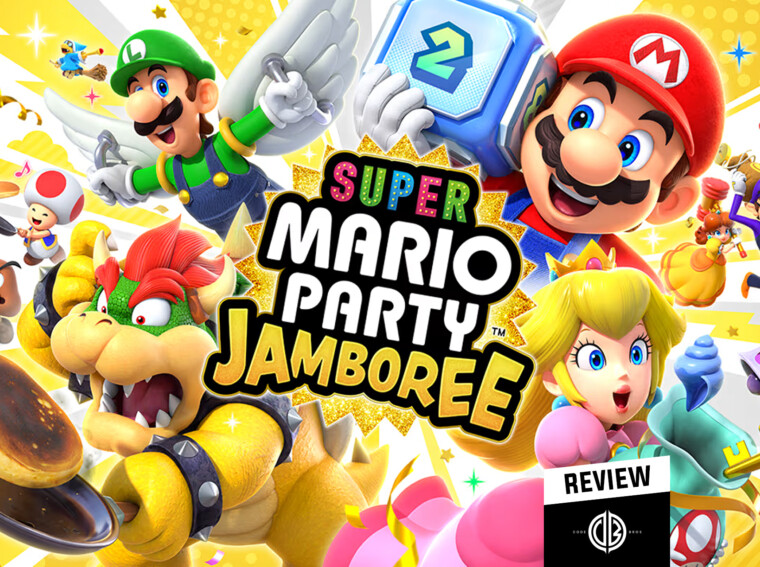
Super Mario Party Jamboree is the series’ biggest bash yet—seven boards, over 110 minigames, and an online hook that makes “one more round” viable on a weeknight. It doesn’t unseat my personal favourite, Mario Party Superstars, but it gives Switch families a fresher, louder playground with real legs.
Super Mario Party Jamboree Review
(Nintendo Switch)
Wahoooooo! It’s-a time to party… some more! Personal excitement spiked at the announcement of the thirteenth Mario Party installment (and the third on Switch) after Super Mario Party (2018) and Mario Party Superstars (2021). I still hold Superstars as my personal favourite; there’s a magic to those N64/GameCube classics, but Super Mario Party Jamboree makes a compelling case on sheer size and momentum. I’ve sunk an embarrassing number of weeknights into it with family and friends; the popcorn disappears, the grudges linger, and somehow the dice keep laughing.
Let’s-a go! The pitch is simple and honest: seven boards, 110+ minigames, and a split between local couch chaos and online gatherings. Koopathlon is the loud new centerpiece where twenty players “sprint” laps around a stadium – your minigame scores convert into forward motion, with Bowser events popping in to yank frontrunners back or slingshot underdogs forward. Bowser Kaboom Squad flips the vibe into co-op: up to eight players pelt an Impostor Bowser with bombs, with rapid-fire team challenges between waves that hand out boosts and items. Both modes can be played solo with CPUs, but they beg for a “Let’s play Mario Party” WhatsApp Group and a free evening, because it really slaps harder the more bodies you cram on the couch.
Regular board play is peak Mario Party. Pick a map, roll big dice, detour through shops and item gambles, and use minigames to swing the standings. The seven-board spread hits a nice gradient: Mega Wiggler’s Tree Party is the gentlest on-ramp; Rainbow Galleria is a compact, interactive mall run; Goomba Lagoon’s tides make it a trickier mid-high; Roll ’em Raceway’s long straights feel more linear but supercharge items; Western Land sits comfortably in the approachable middle; Mario’s Rainbow Castle is small and swingy; and King Bowser’s Keep is the spiky top-end with its Bowser-space Byway that can turn a lead into confetti. As a rough time check, a 10-turn local session can run forty-five to ninety minutes depending on your crew; 15 turns online often creeps toward the two-hour mark. Treat those as ballparks; gimmicks and banter add minutes faster than you expect. It’s the kind of session where you promise “one last turn” and three minigames later you’re bargaining for snacks and overtime.
Between rounds, the village itself; the Party Plaza, keeps you busy in the best way. Party-Planner Trek is a single-player roam across five of the new boards where you help NPCs, scoop up Mini Stars, and bump into short challenges; it doubles as a gentle tour that teaches layouts while unlocking decorations you can place back in the Plaza. Minigame Bay is the endless snack bar: quick Tag Matches when you’ve only got a few minutes, Daily Challenges for a little structure, Showdown battles when you want a proper scrap, Survival runs to test stamina, and pure Free Play when you’re demoing to friends.
Motion-centric side modes live exclusively off of the Plaza: Paratroopa Flight School has you flapping with Joy-Cons for score chases, Toad’s Item Factory turns four-player co-op into a puzzle-box of ramps and levers, and Rhythm Kitchen is exactly what it sounds like: cook-to-the-beat silliness that gets the lounge on its feet. When you want a breather, the Plaza shops are a loop of their own; you can spend Party Points on music, reactions and cards, or poke through the Data House to tinker with your profile and revisit records. It’s dangerously easy to lose an hour tinkering here before anyone even rolls a ten.
Not every board is available from the jump. Four are ready on day one; the remaining three unlock as you tick off Achievements and climb your Player Rank, or by finishing the Party-Planner Trek and rolling credits. In practice that means you’ll see a classic board open at the first milestone, another at the next, and King Bowser’s Keep at the top end after roughly thirty Achievements; or sooner if you prioritize the Trek. The Records menu keeps a tidy list of what you’ve done and what’s left, and a few nights of mixed play—boards, Minigame Bay, and a little Trek—will usually pop the lot without feeling like a grind.
Because folks will ask: Yes, I still have a soft spot for Horror Land in Superstars, and the closest Super Mario Party Jamboree analogue on feel is Goomba Lagoon. It isn’t spooky, but the tide cycle scratches the same “the board state just flipped, plan two turns ahead” itch that Horror Land’s day/night rhythm nailed. If what you love about Horror Land is the lurking punishment, King Bowser’s Keep brings that tension in its own way with clusters of Bowser spaces and nasty reversals. On the flip side, the Superstars board I bounce off is Woody Woods; Super Mario Party Jamboree’s answer there is Mega Wiggler’s Tree Party, which captures the forest vibe but swaps Woody’s gotcha arrow flips for a cleaner, more legible layout you can influence via the Wiggler’s movement. The result is less frustration, more agency. And no, there’s still no official way to import legacy boards across entries; if Nintendo ever green-lights that, I’ll be first in line.
Online has been better than I feared for a late-Switch release. Koopathlon matchmaking fills quickly at sane hours and standard four-player board sessions are workable with friends. You’ll hear reports of the occasional lag spike in jumbo rooms, and friend lobbies cap below the full 20-player Koopathlon madness, but the net result is a mode that you can genuinely drop into solo, make some noise, and bounce out without babysitting a lobby. Locally, nothing beats four folks, snacks, and a friendly grudge; the seven boards are distinct enough to keep a long evening from looping too soon, and the huge minigame pool keeps repeats at bay. On my couch, weeknights blur into “just one more” and the trash talk hits maximum volume long before the turn counter does.
Super Mario Party Jamboree also keeps the Joy-Con party spirit alive with motion-centric side modes (mentioned above), which are literally like five-minute sugar hits that get people off the couch.
Update: 1 August 2025 (Switch 2 Edition)
Nintendo released a Nintendo Switch 2 Edition on 24 July 2025. In addition to the full game, it adds Jamboree TV, a side module with new minigames and features that lean on Switch 2 hardware; Joy-Con 2 mouse-style inputs, the system microphone, and support for a compatible USB-C camera accessory. An upgrade pack is available if you already own the original Switch release. When you boot into the classic Super Mario Party Jamboree mode on Switch 2, the core experience remains essentially the same as the 2024 version; the headline changes live inside Jamboree TV. For clarity: I don’t own the Switch 2 Edition. I’m running the original 2024 Super Mario Party Jamboree installed on my Switch 2; and will update this review if that changes.
Mario Party lives or dies on momentum, and Super Mario Party Jamboree rarely loses the beat. The boards are playful without being fussy, the minigame hit rate is high, Koopathlon finally gives the series a real “jump in, compete, bail” online hook, and Kaboom Squad scratches the co-op itch when your party wants to aim the cannons the same way. If Superstars is the museum of greatest hits, Super Mario Party Jamboree is the modern arcade: bigger, brasher, and built for a crowd.
The game was released on 17 October 2024, and my review copy of Super Mario Party Jamboree was supplied by Nintendo Distributor South Africa. Super Mario Party Jamboree is available both “physically” and digitally. At the time of posting this review, Amazon has it available for R1,299 with next day delivery included, and the digital edition can be snagged via Nintendo eShop for R1,129.